
SCBWI NSW Event, Nov 1, 2020

Maryann Ballantyne
Why do some stories stay with readers long after the book has closed? How do you capture readers from the start and continue to the end? What are key techniques for creating and writing engaging story? What do publishers and editors look for in books? What does it mean to “write what you know”? Why does it work sometimes and fail at other times? How can you write convincingly from a perspective outside of your own? Maryann Ballantyne, a publisher for more than twenty five years, provides invaluable insights into craft for picture books and non-fiction children’s books.
Maryann began by saying how hard writing is. How a story isn’t something that simply pops into someone’s head, that they simply scribe.
As well as hard work, it is also important to gather with other writers, at events like SCBWI. Maryann has been to a few SCBWI conferences and gatherings, and she’s always found them to be joyful and filled with people willing to learn and share. It’s always good to want to learn more.
Maryann reads lots of manuscripts and what she often sees is an enormous amount of lost potential because people haven’t paid attention to process. Ie: Planning, drafting, editing, revising.
She recognised that what she was about to present may not suit everyone but she hoped it could offer a way of building a solid practice to build good work.
She emphasised that the time put into planning, will save time during the writing process.
So What is Maryann’s Planning Process?
Maryann sees people writing furiously for months and then simply pressing send when they’re done. Generally, she believes, that doesn’t work. What you have is draft 0…simply a result of getting the story out. Now the real work begins.
Some more experienced authors only show Maryann their ‘first’ draft when it is really draft 8. When they can no longer work out what to fix, change, delete or rework.
Stories rarely arrived ready-made and most of the time, needs lots more work.
The Thinking and Pre-Writing.
Inspiration comes from all sorts of places. Be ready to write those ideas down. If you write them down, you can think about them differently. It also helps you to remember them.
TIP: Always carry a notebook and pencil.
One Liners
Come up with a one liner that describes your book. Write it in big letters and stick it on your computer so you can see it as you write.
The Outline
Your outline is your itinerary of your story and how you’re going to get there. It may change. You may deviate from it and you will have a good reason for doing it. You don’t have to stick to the plan, because you may find a better route but it will keep you focused. You may even find a better way to get the end goal.
If authors are submitting a non-fiction, Maryann asks them to submit a contents page. For other stories, she’ll ask for a plan. If your structure isn’t working, no matter how great the characters or setting or world, the book won’t work.
The 3 Act Structure
For Maryann, the 3 act structure is key! Have a look at these models to see which one you may like to use. It is sturdy, solid and allows you to create order from chaos.

Freytag’s 3 Act Structure diagram on the internet. Basically it encompasses: Situation, twist, resolution.
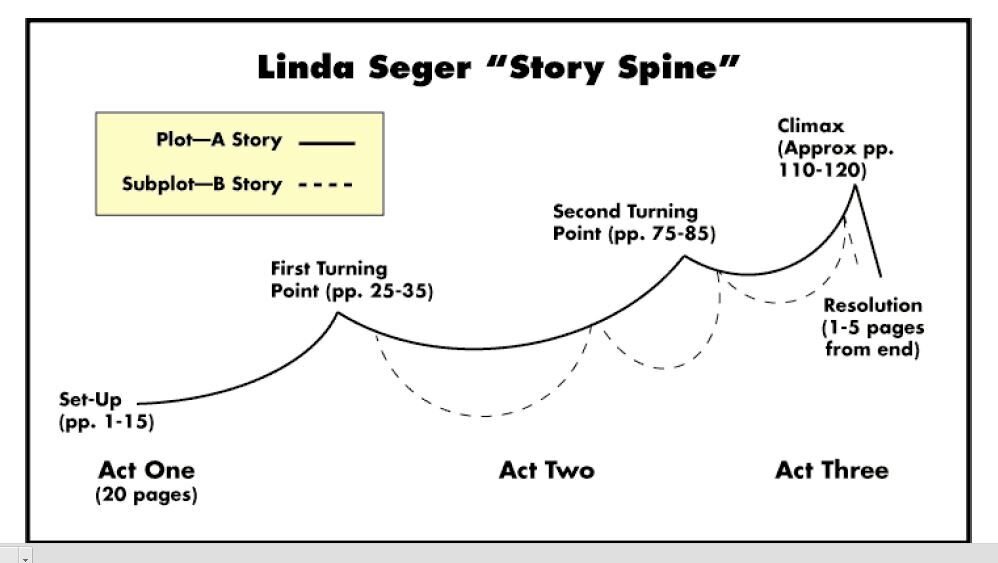
Linda Seger has a 3 act structure…..a spine that runs through a story.

Syd Field is a Hollywood editor/writer
If you are stuck, go back to the structure you prefer. It will help you ask questions about your story. Is the ending too rushed? Is there enough character development? Is there not enough build up to the climax? Is the climax exciting enough? The climax can be quiet but is needs to be a moment of huge change and the main character needs to face a moment of growth.
Stand back from your writing to make sure the structure is sound before you write.
How to do an Outline?
From your one liner, create a persuasive 300 word story description. This has to be your selling copy.
Put your plot and hook in there. Expand on that. Put your time, place and characters, major and minor.
By now you will have all your background info for your pre-story.
You are Ready to Write Chapter One and Beyond
Drop your outline into the chapter buckets. Break your story up. Scenes can be added to, expanded, contracted, get it all down.
TIP: Don’t skip this step.
Writing a story is like packing for a holiday: Maryann will leave a suitcase open and when she thinks of something, she adds it to the bag. That’s how stories build, it is chaotic, but your structure will help create order.
As the outline grows, you’ll see problems, weak plot points, characters you don’t need, characters with no clear purpose. In the outline you can address the pace of your story.
TIP: When you have a problem that seems unsolvable, you can tell someone else and it often sorts itself out….this is true when you write as well. Put your problems in your outline.
We Have Draft 0…What Now?
Revise
Redraft,
Edit.
Step away.
Repeat.
Time away from the manuscript is often a great thing. It clears your mind and you come back to it fresh. Go over your content as a reader when you revisit it.
TIP: Read your story aloud.
Read for voice.
Read for consistency.
Read for POV.
Read for flabby writing.
Remove words from every page. Tighten and tighten again.
Maryann recommends Stephen King’s book, On Writing, which is very good on process.
TIP: Drill down to what your story is about. What are you trying to say? Hold onto this for the whole process.
This a quote from Steve Jobs that sums up perfectly the writing process: ‘Simple can be harder than complex: you have to work hard to get your thinking clean to make it simple. But it's worth it in the end because once you get there, you can move mountains.’
Now Some Questions from SCBWI members
Q. Would you require a one-liner sentence for a non-fiction PB?
Definitely.
Q. I'm writing a novel in diary form and have a million micro scenes, any suggestions as to how to get an outline that's not all over the place?
Write out the story and map it out, making sure your structure it solid.
Q. Could you please expand on what you look for in regards to the hook in a PB?
PBs have to have a saleability factor….not just be cute. It needs to have a bigger picture.
Q. How would you apply the three acts to a PB.
Break up your story roughly into three acts. Is the first act too long, does the problem come too early or late? Is the climax satisfying, is there a major shift in your story, does something happen mid way that makes your character have to act? Is your story balanced?
Jane Austen is great at 3 acts. Where the Wild Things Are is also a good example.
Q. Could you say a little about structure as it applies to storyboarding for illustrators please?
The same storytelling principles apply, but make sure to keep a dynamism in your storyboard. Give the story time to breath, be aware of pace and of course structure.
SCBWI would like to thank Maryann for her time, talent and generosity in sharing her expertise with us today.
Maryann Ballantyne has been a publisher for more than 25 years. She loves stories. Stories that tell us something about ourselves.
For more information on Wild Dog Books:-
Instagram. @wilddogbooks
Facebook. @wilddogbooks
Twitter @WildDogBooks
