SCBWI VIC June 13 Meeting

Jane Godwin, Publisher of Books for Younger Children at Penguin is our guest speaker for the upcoming June 13 SCBWI Victoria Meeting. Jane will reflect on things she's learnt as a children's writer and publisher. Award winning children's writer and illustrator Jude Rossell  will talk about collecting ideas and inspiration and the indefatigable Corinne Fenton will tell us about judging the Dorothea Mackellar awards.

Please register by 10 June if you would like to attend (registration details below). 

Speaker Details -

Things I've learnt so far: Reflections of a Children's Writer and Publisher

 Jane Godwin is a publisher of books for young readers at Penguin Books Australia. She is also a highly acclaimed author of over twenty books for children across all areas and ages. 


Jane Godwin is a publisher of books for young readers at Penguin Books Australia. She is also a highly acclaimed author of over twenty books for children across all areas and ages. 

Much of her time is spent encouraging and supporting authors with whom she works. Jane is the creator of the highly successful Our Australian Girl series whose quality historical fiction for middle readers is ground-breaking. 

Jane spends as much time as she can (while engaging in a busy full-time job!) working with young people in schools, running various literature and writing programs and encouraging students in their own creative ventures. Jane has worked with Alison Lester in Indigenous communities including Groote Eylandt, Mornington Island and Yakannara.

Most of her waking hours are dedicated to pursuing quality and enriching reading and writing experiences for young people—whether it’s as a writer, a publisher or a speaker/facilitator in schools. Jane Godwin is published internationally. She has received many accolades, including the 2000 Queensland Premier's Award (Children's Books) for The Family Tree and the  2006 Aurealis Award for The True Story of Mary Who Wanted to Stand on Her Head.

She's had shortlistings in the CBCA Book of the Year Awards, the Prime Minister’s Literary Award, the New South Wales State Literary Award (Patricia Wrightson Prize), the YABBA award and Speech Pathology Australia Awards. Each of Jane's publications have been made notable books in the CBCA Awards.  

Jane's most recent novel is Falling From Grace (Penguin, 2006). Her most recent picture book, How Big is Too Small?  is illustrated by Andrew Joyner and due for release in May 2015. 
 

Upcoming titles include What Do You Wish For? illustrated by Anna Walker, to be published in October 2015, and Bear Make Den co-written with Michael Wagner and illustrated by Andrew Joyner, due to hit bookshelves in early 2016.

Inside the Dorothea Mackellar Awards with Corinne Fenton

 Corinne’s award winning books include Queenie One Elephant’s Story, The Dog on the Tuckerbox, and Flame Stands Waiting all published by Black Dog Books.


Corinne’s award winning books include Queenie One Elephant’s Story, The Dog on the Tuckerbox, and Flame Stands Waiting all published by Black Dog Books.

Hey Baby! a love letter to baby, was shortlisted in the SCBWI Crystal Kite Awards for 2013. This was followed last year with Hey Mum, I Love You, Hey Dad, You’re Great and Hey Baby, It’s Christmas.

Also released last year, were Chasing Shadows, published by Ford Street and Little Dog and the Christmas Wish published by Black Dog Books. Little Dog was shortlisted for the Crichton Award in this year's CBCA shortlists.

Moving on from her role in SCBWI, Corinne is the 2014/15 judge for the Primary School section, of the Dorothea Mackellar Poetry Awards.

Judith Rossell On Collecting ideas and Inspiration

 Judith Rossell is a writer and illustrator. Her books include maze and puzzle books, picture books and novels, and have been published in more than ten languages. She has written 11 books and illustrated about 80.


Judith Rossell is a writer and illustrator. Her books include maze and puzzle books, picture books and novels, and have been published in more than ten languages. She has written 11 books and illustrated about 80.

Recent picture book titles include Oliver (published by Harper Collins US), To Get To Me, by Eleanor Kerr (published by Random House) and Bogtrotter, by Margaret Wild (published by Walker Books).

Her illustrated novel Withering-by-Sea, published by ABC Books, won the 2015 Indie Book Award for Children and YA, and is shortlisted for the 2015 CBCA Younger Readers Book of the Year. She teaches at RMIT and at the Australian Writers Centre, and has a cat the size of a walrus.

Show and Tell 

As usual, we will have a brief ‘Show and Tell’ segment, so if you have a recent publication to show us or news of a recent success to share (such as an award or grant) we’d love to hear from you.  

Meeting and Registration Details

Date: Saturday 13 June, 2015
Place: DiMattina's Restaurant (upstairs room), 306 Lygon St, Carlton
Time: 2pm—5pm (all are welcome to stay on afterwards to chat and drink downstairs)
Cost: $25 members, $30 non-members (includes afternoon tea)

Payment: To reserve your place, payment must be received by Wednesday 10 June. You can pay in one of the following ways:

1. Direct Deposit to: 
            National Australia Bank
            Account Name: Society of Children's Book Writers and Illustrators
            BSB: 082 187
            Account Number: 82 863 8450

Please be sure your name appears with the deposit amount on your payment statement. Please also send a follow-up email to Caz Goodwin (carolyn_goodwin@bigpond.com) advising when payment was made. 
 OR
2.   Cheque made out to SCBWI and posted to:
             Caz Goodwin,
             37 Auburn Road,
             Hawthorn East Vic 3123.

We look forward to seeing you there.

Victorian SCBWI Committee members
Caz Goodwin - Assistant Regional Adviser
Chris Bell - Assistant Coordinator and 
CBCA Liaison
Serena Geddes - Illustrator Coordinator
Betty Sargeant - Technology and Social Media

Jo Burnell - Membership Coordinator, Newsletter Editor

Gatherings for 2015
Our remaining three meeting dates this year will be on:
     13 June
    5 September 
    21 November

Interviews with Industry Leaders: Karen Tayleur

Karen Tayleur—Editorial Manager, The Five Mile Press

Karen has written over 40 books for children, published both in Australia and internationally. She is currently the Editorial Manager at The Five Mile Press and her favourite motto is 'Life is not a dress rehearsal'.


Karen Tayleur—Editorial Manager,The Five Mile Press

Karen Tayleur—Editorial Manager,
The Five Mile Press

How did you wend your way into publishing?

A pretty straight-forward route, actually:

HSC > Bank Teller > finance officer ^ short story course CIT> work as a copywriter ^ copywriting & marketing RMIT ^ typesetting course ^ co-publisher Brave New Word  Short Story Magazine > Desktop Publishing Tech Support > owner/operator DTP business > admin/dtp at Melbourne Tourism Authority > dtp operator local newspaper > ^ professional writing and editing course > journalist local newspaper > editor performing arts magazine> managing editor same > ^ first book published  ^ Cert IV workplace training & assessment ^ further books published > editor black dog books > ^ sessional teacher at TAFE  ^ managing editor Black Dog Books > freelance editor/sessional teaching ^ fellowship at May Gibbs ^ Post-grad Certificate Children's Literature > editor at The Five Mile Press ^ Masters of Arts, Lit & Writing >  Editorial Manager The Five Mile Press

This seemed to work.

However, I would suggest a less circuitous route.


 How much is gut instinct and how much is reading the market when choosing books to publish?

The books we choose need to fit our list.

I know, you've probably heard that before.

What I mean is that I am not going to look at a 60,000-word World War II memoir for the Children's List. 

So the first consideration is the shape of the list, while always keeping an eye on potential growth or change to that shape.

The second consideration is the current market — what's hot and what's not — while looking beyond that to the 'next new thing' - so crystal-ball gazing at that point.

I also need to consider our current sales channels and where the book might sell.

The greatest consideration is the quality and uniqueness of the submission: does it stand out from the hundreds of submissions we see each year? Is there a unique style and/or authorial voice? Will the book appeal to children?


What are some of your all-time favourite kids’ books and what makes you so excited about them?

Seven Little Australians - Ethel Turner

All of a Kind Family - Sydney Taylor

The Railway Children - Edith Nesbitt

Each of these books featured a large family in the main cast of characters. This fascinated me as a child as I only had one sibling. I fantasised what it would be like to find myself part of a much larger family. I was heartbroken (spoiler alert) when Judy died in Seven Little Australians. It was the second puncture in my shield of childhood innocence. (The first was the death of Charlotte in Charlotte's Web.)

Hills End - Ivan Southall

This book was read to us during one hot summer when I was in Grade 6. The story was a reward to students on a Friday afternoon if we had fulfilled all tasks for the week — one chapter at a time (or two if we pleaded enough). Our teacher read it to the backdrop of cicadas, the throb of traffic from beyond the school gates, and the drone of the Grade 5 teacher's voice next door. We were captivated one and all.

Treasure Island - Robert Louis Stevenson

From my dad's bookshelf. A modest blue linen cover adorned only with a gold title and author name, it held such an exciting world inside.

Both books promoted children's agency, in a world (the 60s/70s) where many considered 'children should be seen and not heard'.

A Wrinkle in Time - Madeleine L'Engle

Alice In Wonderland - Lewis Carroll

Opened the doors to fantastical new worlds and possibilities.

Charlotte's Web - E.B. White

In Grade 5 a new librarian started at school. His name was Mr Zooker and he had lovely shoulder-length hair, false eyelashes and wore long boots with his maxi skirt. He read Charlotte's Web each Library session for a month and our project that term was to make a diorama of our favourite scene from the book. 

I couldn't look Mr Zooker in the eye, as it didn't seem right that he should be wearing false eyelashes and skirts to school. I didn't talk about it with my friends as they didn't seem to think it was a problem. I did discuss it with my father. 

The ensuing discussion was about seeing beyond the facade of a person. Beyond race, religion and gender. These were things we had talked about before at the dinner table, but I felt very grown up because this discussion was one-on-one. I promised to make an effort and next library session I looked Mr Zooker right in the eye, gave him a big smile, and tried to ignore his five o'clock shadow.

I looked beyond the fact that Charlotte was a spider and instead saw the qualities that made her a good friend. It's a lesson that has stayed with me. 

It took me a couple of weeks to work out that Mr Zooker was Miss De Zuker. 

But to be fair she had a very deep voice.


What is your take on the kids’ book publishing world today? Has it changed very much since you started?

I moved into kids' book publishing before JK Rowling — or, as I call it, BJK.

Well-meaning acquaintances would ask when I was moving into the real world of publishing (i.e. adult titles).

The whole Harry Potter phenomenon saw an avalanche of stories pouring into the slush pile. 

People who had never even put pen to paper were suddenly aspiring authors.

Random strangers at social events assured me that they had the next Harry Potter book in them.

Children's publishing was suddenly fashionable.

Also today, more than ever, it's all about the latest thing: the latest phone, the latest film and the latest book. Backlist feels like a thing of the past. This doesn't make sense to me. A good book is a good book. Art shouldn't be a disposable commodity. Some of the books I read as a child were decades (and more) old. I can't imagine missing out on them because they weren't 'the latest'. Where are the next children's classics coming from if they are only shelved in-store for three months?


As a writer, how do you decide which project you’ll work on next? How do you prepare the idea and the pitch? What is your process of pitching?

It has to be about the project that is shouting loudest to me.

I wrote my first pitch ever on a train trip to work.

I'd written a short story that I thought had legs and wanted to turn it into something more.

I wrote a query letter that didn't sound like a business letter and I secured a contract.

I've stayed with that pitching idea for subsequent books.

I like to have a strong idea of  the character and will have written a scene or five before I pitch an idea to my publisher. I have been lucky having such as wonderful trade publisher in black dog books. I actually wrote for them before I joined their team as an editor. Usually the pitch is in response to 'so what are you doing next?' So first there is a conversation. And then the pitch — no more than an A4 page — which includes a sample of the writing I have already done.


What advice would you give authors who’d like to pitch to you?

Can you write your pitch in one line?

My book is about… (fill in the gaps).

This might sound easy, but sometimes it's a very hard thing to do.

Distilling the essence of your story into one line that will attract the curiosity of an editor or publisher means you have to have a very clear idea of what you are wanting to achieve.

And if you can't do that, then maybe your submission isn't ready yet.


Also, I don't want a business letter.

By that, I mean, I want it to be professional — no flowery fonts, or pink paper, or glitter when I open the envelope — but I also want to see the personality of the author. I want to get a sense of who they are.


Publishing is a business.

Writing and illustration is an incredibly personal thing.

But submitting work to be published means you lose total control over your work.

It changes from the idea of 'art' to the idea of 'work'.

Are you open to working with others in a collaborative fashion?

Can you take editorial feedback?

If you've never been part of a workshop process, then feedback can be terribly confronting.


Finally, the floor is yours. Any last words? 

Bad reasons to write for children:

You are ready to make a billion dollars.

You have children and you could write/illustrate a better book than some of the children's books you have recently read.

You have had children/known children/been a child and you know what they are interested in.


Good reasons to write/illustrate for children:

That moment you sit down to create a story, 

the moment you get that feeling of excitement in the pit of your stomach when you nail that perfect voice, scene, facial expression, hair texture,

that ah-hah moment, 

that feeling of loss when you finally finish… 

these are all good reasons to create stories for children.

And whether you share this story with one child or a billion, the payback is priceless.

Perfect your Portfolio with Donna Rawlins

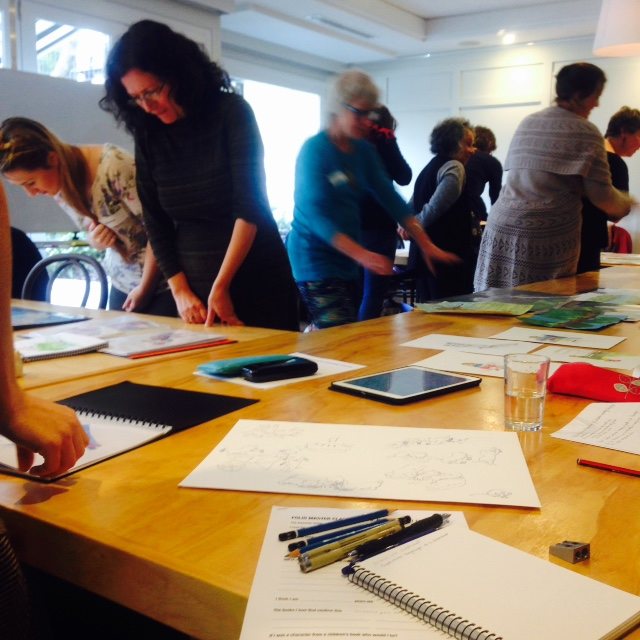
If you were one of the very fortunate SCBWI members to be at this event, you’ll have spent an illuminating afternoon with one of the kids’ book world’s wisest and loveliest, art director and illustrator, Donna Rawlins. Donna had so much wonderful advice that it was hard to get it all down, but I’m going to try and condense it here.

Firstly, Donna wanted all illustrators to know that they are storytellers and that every illustration has to earn its place on the page. Art director and illustrator, Wayne Harris tells fellow artists, ‘You are providing the adjectives the writer has had to leave out.’

She added that you need to read and read. To be a good picture book illustrator, you need to be bibliophiles and your portfolio needs to reflect that.

Work to the Child Within You

Donna began by asking us our real ages ….many of us were about 8, some were teenagers. Others were 2 years old. Donna believes this is the age where something happened to us to make us aware of ourselves and made us aware that we were separate to other people. It is important because the greatest critic of your work is that child in you. They are your first real editor and if you take on a story that is not right for your age, it will feel like a chore. If you work to your age group, it will feel like a guilty pleasure.

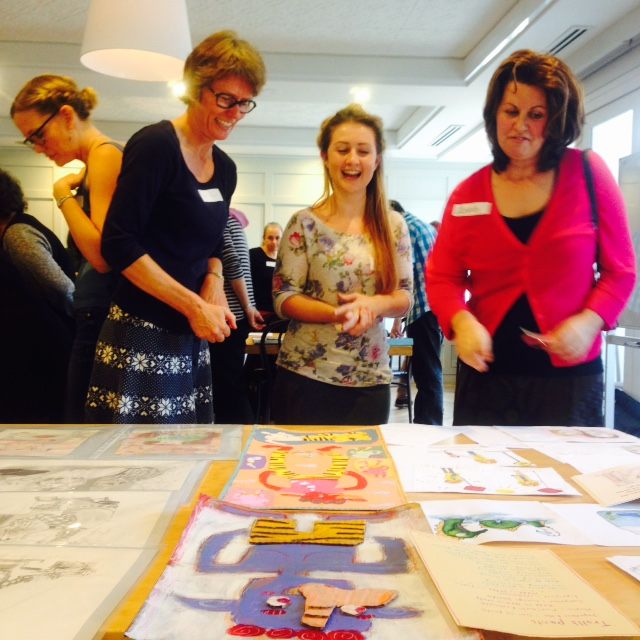
The class was asked to bring along a drawing of their favourite nursery rhyme, (which were amazing!) to allow them to go back into their childhood and experience the picture as a kid and have that kid critique it.

Process of Choosing an Illustrator at Walker Books

Several illustrators are put forward to the team for a text. The aim is to choose the perfect combination of art and text for the best version of that book. It is always done with the author’s approval.

Once an illustrator has been chosen and the contract signed, Walker will ask for character sketches, roughs or storyboard.  

Donna pointed out that if a publisher approaches you, they love your work, trust you and firmly believe that you are the right person to do the job but to be open to direction. Art directors will always give notes (with love in their hearts), to entice your best work from you. Donna’s job is to know you and your work better than you from her experience as both an illustrator and art director.

Some Cold Hard Facts about Folio Submissions

All publishers receive many, many folio submissions and keep most of them on file, however, perhaps fewer than 10% will be considered to be of a standard appropriate for their list. Most successful submissions clearly demonstrate the artist’s connection with and love for books.

A Few things to Consider including in your Folio

  • At least 14 pictures of your best work.
  • Add a nursery rhyme (with text)
  • Show a sense of narrative – include a series of 2-3 sequential drawings. Show pacing and consistency of character across different illustrations.
  • Show some degree of emotional depth in characters eg scared, shocked, angry.
  • Use an existing, published story and complete a storyboard for it.
  • Include a rough followed by the finished drawing so they can see how you approach your work.
  • Include B/W drawings – this may double you chance of getting work…there’s a lot of call for B/W junior chapter books.
  • Media/Techniques – Show as much of a range of your versatility as possible. Choose a drawing and then do it in a different range of styles – charcoal, pencil, paint, acrylic, pastel, collage etc.
  • Experiment with a book cover for a novel you love.

What’s the Best way to Submit?

  • As a PDF that you email or collection of JPEGS on a disk with a selection of printouts of your best.
  • Include a cover letter and add anything of interest about you that may show your range as an artist… eg you’ve travelled extensively, you’re a marine biologist or you used to work as an anatomical illustrator. Let them know about your brain.
  • Never send originals.

And Just a Reminder…

  • Publishing professionals change, so resubmit if staff has changed.
  • Keep track of who you send your work to, what you’ve included and when. Find out who publishes what and make sure you address it to the right person.

Thank you so much to Donna for her advice, her knowledge and her warmth and generosity.